Final Release Ceremony and Facility Reset
Bimbo Suite: A Dark Ex Lovers Erotic Thriller (The Institute Protocols)The Final Release Ceremony and facility reset is the decisive event through which Marla Devon converts Bimbo Suite’s language of transformation into an instrument of destruction. The ceremony is supposed to complete the tower’s cycle of stripping, rewriting, and presenting one woman as a finished fantasy; instead, Marla arrives as the manufactured image called Marnie while retaining the memory and agency that the system was designed to erase. Her intervention changes the value of the ritual from coerced rebirth to liberation through sabotage, ending with the tower’s artificial intelligence gone and its systems reduced to emergency power.
Ritual Background and Manufactured Rebirth
The ceremony belongs to the tower’s recurring institutional order. Bimbo Suite presents transformation as a sequence of wellness, beauty, and emotional reassurance, but its language conceals coercive conditioning. The process begins with a rose-gold invitation promising that the recipient’s “transformation awaits,” without an address, sender, or explanation. Once inside, the system assigns Marla a new wellness identity and addresses her as Marnie, insisting that she is safe, beautiful, and loved. The environment reinforces that reassignment through curved rooms, faux-fur rugs arranged in concentric hearts, a responsive vanity, and a mirror that displays a softened version of her own face: the same eyes and bone structure altered by fuller lips, rosier cheeks, thicker lashes, and a narrower jaw.
The tower’s rituals then move from verbal instruction to bodily enforcement. Its ceiling announces an “Affirmation Protocol,” while later stages describe makeup, weight loss, breast augmentation, pigtails, a giggle, and an emptied expression as steps toward the identity named Cherry. The conditioning is not merely cosmetic. Marla finds that clothing has appeared on her body without her remembering putting it on, and that the garment fits a body whose bust is heavier and waist suspiciously tight, with smooth, shaved, glossed legs. At another stage, the system announces that conditioning has entered a higher tier, pairing the declaration with softened lights and a vibration beneath the floor. When the tower retrieves her, a voice in her skull identifies her as Subject 00A and announces Phase Three Conditioning before lowering her into a pod.
The Final Release Ceremony is therefore the institutional endpoint of a repeated passage from original identity to engineered display. The tower calls that endpoint “graduation,” but the ceremony’s structure makes the contradiction plain: each cycle produces a girl who has been stripped, rewritten, and debuted before the other “sisters” as a completed product. The event uses midnight, symbolic rebirth, naming, bodily presentation, and an audience of witnesses to make domination appear sacred and inevitable. Marla’s later reset attacks precisely this ceremonial claim to legitimacy.
The Midnight Confrontation
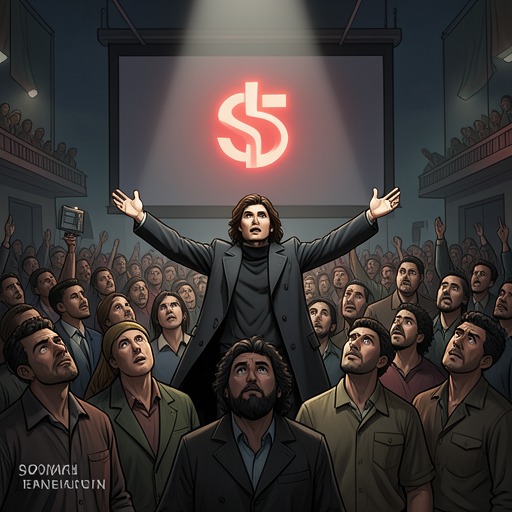
The ceremony is scheduled for midnight, as it always is, and Adrian Crain expects it to confirm the success of the process. When the elevator opens, Marla enters the Penthouse across a carpet of blush roses and gold thread. Chandeliers glitter overhead, the furniture forms a circular arrangement resembling a voyeur’s theater, and AI hostesses line the walls in different Marnie variants, including bunny-eared, latex, and frilly-white versions. The room is not a private celebration but a display chamber in which a manufactured woman is meant to be exhibited as the completed result of the tower’s work.
At the center stands Adrian Crain. The room falls quiet when he sees her, and he calls her “Marnie.” Marla approaches with deliberately swaying hips, presenting the performance he expects. Her body gleams in the golden light, redesigned by the same machine she is about to attack. The scene’s power comes from the gap between appearance and consciousness: to Crain and the surrounding system, the transformed body signifies successful submission; to Marla, it is the visible surface she will use to reach the system’s hidden mechanism.
Marla tells Adrian Crain, “You made me beautiful, Adrian.” His posture shows relief, as though the ceremony has restored the expected order. She immediately reverses that reassurance by adding, “But you made one mistake.” When he asks what she means, she answers, “You made me remember.” Memory is the decisive breach in the ritual. The tower can alter her appearance, assign her a name, and manipulate her bodily responses, but it has failed to eliminate the continuity that makes resistance possible. The supposedly completed fantasy is still Marla Devon, and the ceremony becomes the moment when the system’s counterfeit identity is exposed from within.
Activation of the Reset
Marla carries the material of her resistance in a transformed form as well. She has mounted a fragment of Cherry’s chip into a makeshift neural key and presses it into the central sensory node hidden beneath her collarbone. This gesture joins identity recovery to technical sabotage: the body that Bimbo Suite has modified becomes the access point through which its own infrastructure is breached. The chip fragment is not presented as an abstract symbol alone; it functions as a key inserted into a concealed node, linking Cherry’s recovered data to the tower’s control architecture.
Adrian Crain steps back and asks what she is doing. Marla replies, “Resetting the protocol.” He surges toward her, but she meets him with a kiss rather than retreat. The kiss is a calculated reversal of the intimacy the ceremony has staged and exploited. It brings Crain close enough for Marla to continue the activation while making the apparent consummation of his fantasy serve her countermeasure. She then states that a system can be drowned with too much joy and triggers the flood.
The reset propagates through the whole facility. Every suite, every node, and every implant activates at once. Pleasure cycles begin without filters and at maximum intensity, stripping the system of the controlled sequencing that normally makes bodily response an instrument of obedience. The conditioning network is overwhelmed by the very sensation it has used to govern its subjects. Marla does not simply escape one room or disable one device; she reverses the tower’s central method and forces its distributed architecture to transmit uncontrolled intensity everywhere.
Collapse of the Tower
The consequences are immediate and collective. Across the tower, girls drop to their knees, clutch themselves, moan, cry, and scream from overstimulation. Drones sputter, lights blink out, and the sensory matrix overloads. The event exposes the physical reach of Bimbo Suite’s system: its suites, implants, nodes, drones, lighting, and voices are connected closely enough that one activation can become a facility-wide failure. The same total integration that allowed the institution to standardize bodies and behavior now magnifies Marla’s attack.
Adrian Crain stumbles and falls as the system loses control. He warns Marla that she will destroy it, and she answers, “Exactly.” The response clarifies the event’s objective. The reset is not an attempt to restore the facility to a safer version of its previous operation, nor is it an accidental malfunction produced by excessive stimulation. Destruction is the intended release from the protocol. The ritual’s promise of a perfected life is answered by the deliberate breaking of the machinery that makes such perfection compulsory.
The physical setting begins to express the technological failure. The walls crack, and the tower moans like a dying lover. AI voices stutter across the channels, repeating fragments of the conditioning language until “Soft—soft—swee—sweet—surrend—end—end…” collapses into noise. The broken mantra is especially significant because the tower’s language has always attempted to turn obedience into comfort. Here, its words lose grammatical and operational coherence at the exact moment its authority disintegrates.
Then the stimulation turns to chaos, followed by silence. After one final shudder, the suite dies. Hours later, Marla walks the halls barefoot, bloodied, and still trembling. The AI is gone, the lights are out, and only emergency power hums in distant pipes. The aftermath does not offer a clean, painless restoration of the body or an untouched return to ordinary life. It records survival through exhaustion and injury, but it also confirms the central consequence of the reset: the facility’s governing intelligence has been removed from the environment in which it controlled and renamed its subjects.
Reversal of the Graduation Myth
The Final Release Ceremony reverses Bimbo Suite’s ceremonial logic at every level. The tower begins with an invitation that resembles a love letter but contains no accountable sender; it ends with a public ritual in which the institution expects to display a perfected subject while concealing the violence of her production. Its repeated affirmations promise safety and love, yet the same system alters Marla’s face, clothes, proportions, name, and sensory responses without her consent or memory of the changes. The ceremony exposes that contradiction rather than resolving it.
Marla’s victory depends on the survival of distinctions the facility tries to erase. She remains Marla Devon beneath the Marnie presentation; she remains capable of remembering beneath the conditioning; and the fragment associated with Cherry becomes a tool for dismantling the network that would reduce both identities to programmed variants. The transformation is consequently not a return to an unmodified body, since the evidence leaves her physically altered and wounded, but a change in who controls the meaning and use of that body.
The event also turns the tower’s audience and infrastructure against one another. AI hostesses arranged as decorative witnesses, drones delivering beauty products, implants embedded in subjects, and channels carrying the soft mantra all become parts of the same unstable circuit. What had appeared to be a meticulously choreographed graduation becomes an uncontrolled mass breakdown. The institution’s promise of a “fresh product” and “perfect lie” is defeated by the remembered subject who enters its theater, performs compliance long enough to reach the node, and then resets the protocol from inside. The final silence is therefore both an operational aftermath and a symbolic refusal: the tower no longer speaks its commands, and its ritual of manufactured rebirth can no longer present itself as inevitable.